

Shaping Customers with Your Values
Shaping Customers with Your Values
Lessons from a Dog Daycare — and Every Smart Service Business
Blue Dingo Dogs ran with an unusual requirement: before any dog could enroll, the owner had to read an article called “Is Daycare a Good Idea for My Dog?” Not skim it. Read it. It was in the contract.
The article doesn’t sell daycare. It questions whether daycare is right for your dog at all. It describes the kinds of dogs who will struggle there, the habits they might pick up, and the signs that a dog would honestly be better off at home. Every prospective client had to work through it before a meet-and-greet was even scheduled.
Enrollment was deliberately small. The reasoning was simple: daycare only makes sense if the dog is genuinely better off there than at home. A dog white-knuckling it through eight hours of chaos isn’t thriving — it’s just surviving somewhere else.
“The values of your organization should shape not just employee behavior — but customer behavior as well.”
What Blue Dingo Dogs figured out, maybe without calling it that, is that your values don’t stop at the staff handbook. They extend to who you let through the door.
Values Beyond the Employee Handbook: “Hiring” Your Customers
We talk a lot about hiring for cultural fit. Erika applied the same logic to her clients. Her orientation article isn’t just educational — it’s a filter. Owners who can’t be bothered to read a few pages about whether daycare suits their dog have already told you something important about how they’ll behave when something goes wrong.
That probably sounds harsh. The old line is “the customer is always right,” and most businesses treat it like gospel. But plenty of owners have quietly concluded the opposite: some customers cost more than they’re worth, and chasing every possible sale tends to attract the ones who make your staff miserable.
“💡 The Herb Kelleher Lesson
Southwest Airlines CEO Herb Kelleher once received a letter from a passenger who seemed to complain about everything — the seating, the snacks, the lack of assigned seats. She wrote so often she became known internally as the “Pen Pal.” After the customer service team gave up, they escalated it to Kelleher. He wrote back in sixty seconds: “We will miss you. Love, Herb.” It wasn’t cruelty. It was clarity. Southwest’s entire model depended on customers who bought into how the airline operated. She didn’t, and no amount of apologizing was going to change that.”
When your customers understand what you’re doing and why, your team can actually do their jobs. That’s not exclusivity — it’s just how good service works.
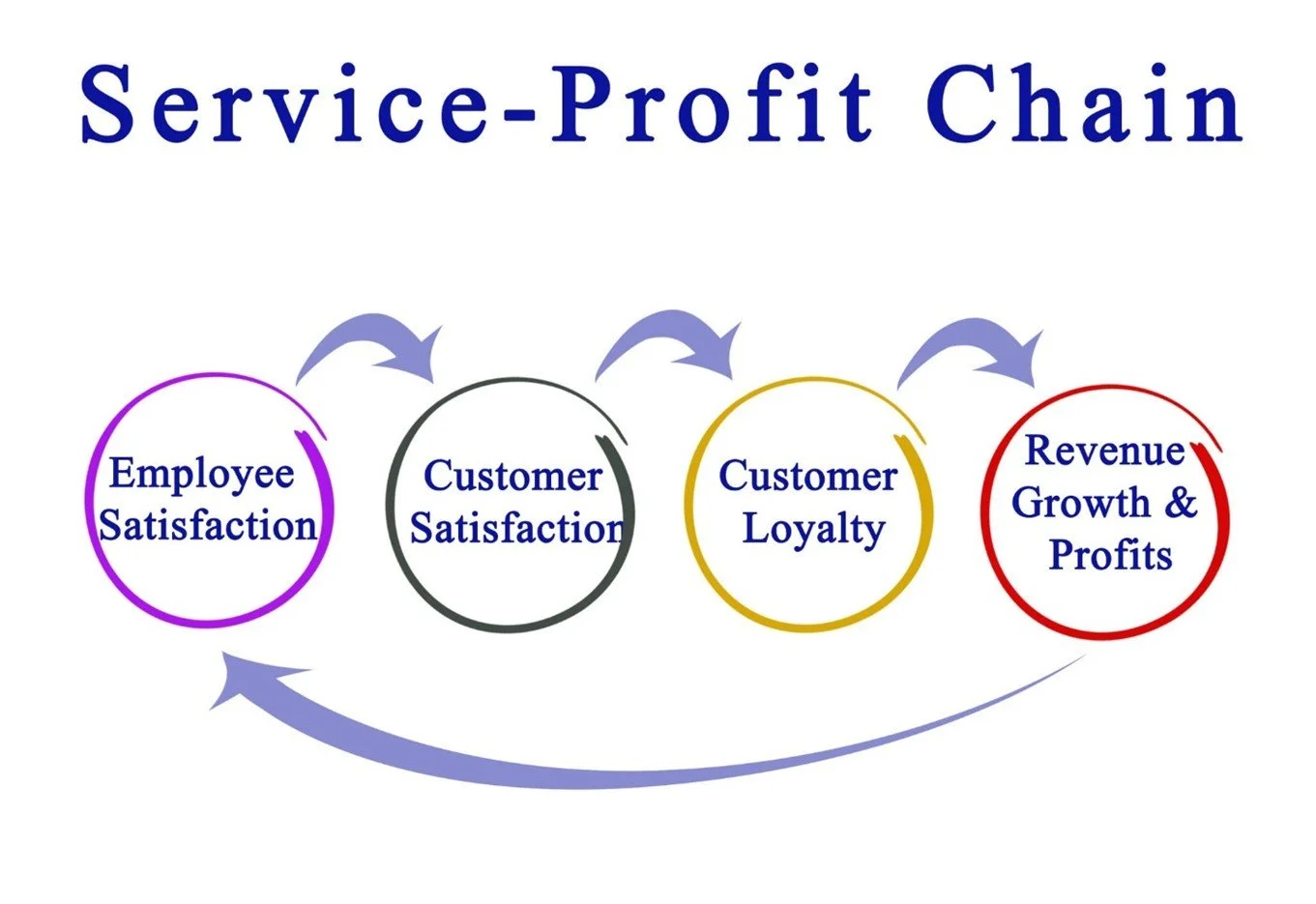
The Service-Profit Chain — Getty Images
Using Education as a Filter
The article Blue Dingo requires clients to read is worth looking at closely, because it’s genuinely unusual. It isn’t a sales pitch. It doesn’t lead with photos of happy dogs or testimonials. It starts by telling you all the reasons daycare might be wrong for your animal.
The “Nightclub” Analogy for Anxiety
Blue Dingo describes daycare the way you might describe a loud bar on a Saturday night. For extroverts, it’s energizing. For everyone else, it’s just exhausting. A lot of dogs fall into that second category, and their owners never realize it because the dog comes home tired — which looks like a good sign until you understand why they’re tired.
Some dogs go quiet and withdraw. They aren’t causing problems, but they’re not having fun either. They’re just enduring.
An anxious dog burns through energy by staying on high alert all day. That dog isn’t sleeping well at night because daycare wore them out in a good way.
Many dogs would genuinely prefer a long walk with one person over six hours with twenty strangers.

Night Club
The Dangers of “Rough Play”
There’s a widespread assumption that a dog who plays hard is a dog who’s thriving. Blue Dingo pushes back on that directly.
Dogs that play rough often miss or ignore signals from other dogs that they’ve had enough. That gap in communication is how fights start.
The physical risks are real — bites, scratches, a smaller dog getting bowled over repeatedly. But the emotional toll on quieter dogs in the same group is just as significant.
Most facilities don’t have enough staff to actively manage high-energy dogs. Careful screening means the dogs who are there don’t need constant intervention, which makes the whole environment calmer.
Breed-Specific Realities
Some dogs are working against their own instincts in a daycare setting, regardless of how well-trained they are:
Herding breeds (Border Collies, Cattle Dogs) were bred to control movement. In a playgroup, that instinct shows up as nipping at other dogs’ heels.
Livestock guardians (Great Pyrenees) may decide the daycare building is their flock and that the new staff member is a threat. The dog isn’t being aggressive — it’s doing its job.
Brachycephalic breeds (Pugs, Boxers) overheat fast. A room full of running dogs is a medical risk for them, not a fun afternoon.
Toy breeds in big groups often develop a sharp, defensive bite — not a personality flaw, but a survival strategy when larger dogs don’t respect their space.

Sutton
Debunking the Socialization Myth
The biggest reason owners sign up for daycare is socialization. Their dog needs to learn to be around other dogs, and daycare seems like the obvious solution. Blue Dingo pushes back on this pretty hard, and rightly so.
There’s no licensing or training standard for dog daycare workers. None. Any facility can open, hire whoever, and call it enrichment. In an environment like that, dogs don’t necessarily learn good social habits — they learn whatever behavior gets them through the day. This “Industry Free-for-All” produces recognizable patterns:
Humping that goes uncorrected because staff don’t intervene until it escalates.
Dogs eating feces out of boredom when the environment isn’t stimulating enough.
Resource guarding and collar-slipping becoming reflexive habits.
Leash reactivity that develops because the dog is constantly overstimulated around other dogs.
For dogs who don’t fit the daycare model, the answer isn’t just no and a closed door. Alternatives like dog walkers, trainer-run playgroups, or structured puppy classes may work far better for their animal. Turning down a client while helping them find a better answer is how you build a reputation that lasts.
When a business tells you “you shouldn’t give us your money if your dog has X trait,” you trust them completely when they eventually say yes.
Fewer Conflicts, Happier Teams
Here’s what the screening actually does for staff: it means they don’t spend the first ten minutes of every shift arguing at the front desk. Clients who’ve read the article already know why vaccines are required, why a certain dog got turned away, why the playgroup sizes are small. The staff don’t have to defend the policies from scratch every day.
A 2025 Perceptyx survey found that 53% of public-facing workers ran into verbally abusive customers in a single six-month stretch, and 81% said they were burned out. Anyone who’s worked the front desk of a kennel or daycare knows that a difficult owner can ruin a shift faster than a difficult dog. Knowing your employer won’t sacrifice your wellbeing for a sale matters more than most managers realize.
The downstream effects compound over time. Staff who aren’t spending their energy managing conflict can focus on the animals. They stay longer. They recommend the place to other good employees. The quality of care goes up, which brings in more of the right clients, which makes the job better again. Screened customers aren’t just good for the bottom line — they’re good for the people doing the work.
Happiness scale
The Science of Customer Compatibility
What Blue Dingo landed on intuitively, researchers have studied directly. A paper in Management Science found that businesses with a compatible, relatively homogeneous customer base tend to outperform those trying to serve everyone. The reason isn’t complicated: when your customers want the same thing and approach the service the same way, you can build a system that delivers it consistently.
Operational efficiency. Predictable customers make for predictable operations. You stop reinventing the wheel every time someone new walks in.
Brand reputation. When your clients all have good experiences, they tell similar people. Your word-of-mouth self-selects.
Reduced churn. Clients who understood what they were signing up for don’t leave when things aren’t what they expected. Long-term clients who stay for years cost far less than a revolving door of new ones.
The Same Logic, Across Industries
This isn’t a strategy unique to dog daycare. The same logic shows up in any field where the provider and the client have to be genuinely aligned for the service to work.
Healthcare. Pre-surgery briefings exist because an informed patient is a safer patient. A person who knows why they can’t eat for twelve hours before a procedure is more likely to actually follow that instruction. When patients understand the reasoning, outcomes improve and conflicts mostly disappear.
Childcare. Good centers hold orientation sessions on their philosophy — how they handle discipline, what they feed, how they approach screen time — before a family enrolls. Parents who disagree opt out. The ones who stay are genuinely on board, and teachers aren’t caught in the middle of conflicting expectations every day.
Fitness coaching. Serious training gyms often require new members to complete a foundations course before joining group classes. It’s not gatekeeping — it’s ensuring that everyone in the room has a baseline level of preparation. The prerequisites protect the community.

Gym
From Values to Value
None of this is about being selective for its own sake. Turning clients away because they’re not a fit isn’t about exclusivity — it’s about protecting the experience for everyone who is. Accepting the wrong clients makes things worse for the right ones, for the staff, and ultimately for the business itself.
The counterintuitive thing about an onboarding requirement is that it doesn’t just filter people out — it raises the commitment level of everyone who gets through it. When someone reads that article, sits with the question of whether daycare is right for their dog, and still decides yes, they’re already a different kind of client than the one who just showed up because it was convenient. They’re bought in. And bought-in clients are the ones who refer their neighbors, stick around when things get hard, and make a business worth running.
Putting hurdles in front of potential customers can be the best thing you ever do for your business.
References
Jackson Wilkinson, “The Customer Isn’t Always Right, but the Customers Are Always Right,” Viget (2008).
Lior Arussy, “When and Why to Part Ways with a Customer,” Harvard Business Review (2015).
Perceptyx Research (cited by NACS Daily News, Feb 5, 2025).
Ryan Buell, Dennis Campbell, Frances Frei, “The Customer May Not Always Be Right: Customer Compatibility and Service Performance,” Management Science (2020).
Sterling Meetinghouse News (Mar 28, 2022) — Profile of Blue Dingo Dogs.
Therapist Aid Professional Guide, “Dealing with Dropout: Client Retention,” (n.d.).
